Use cases
Any task where a person could point at the thing in an image and draw around it is a Model Bench use case. Most run on the Standard edition; acceleration and measurement need Pro. Typical marks applications the product supports that are not yet a named customer reference.
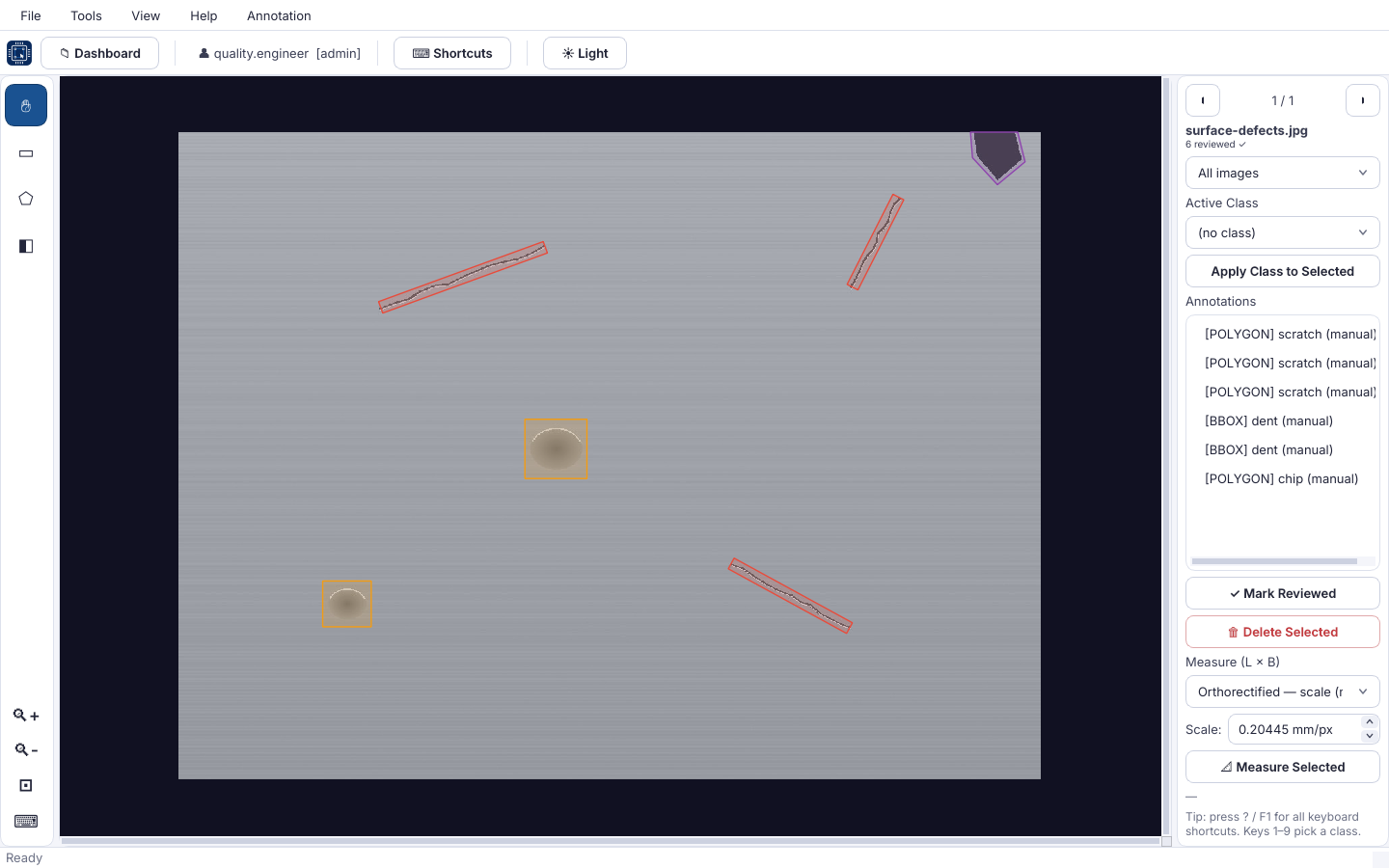
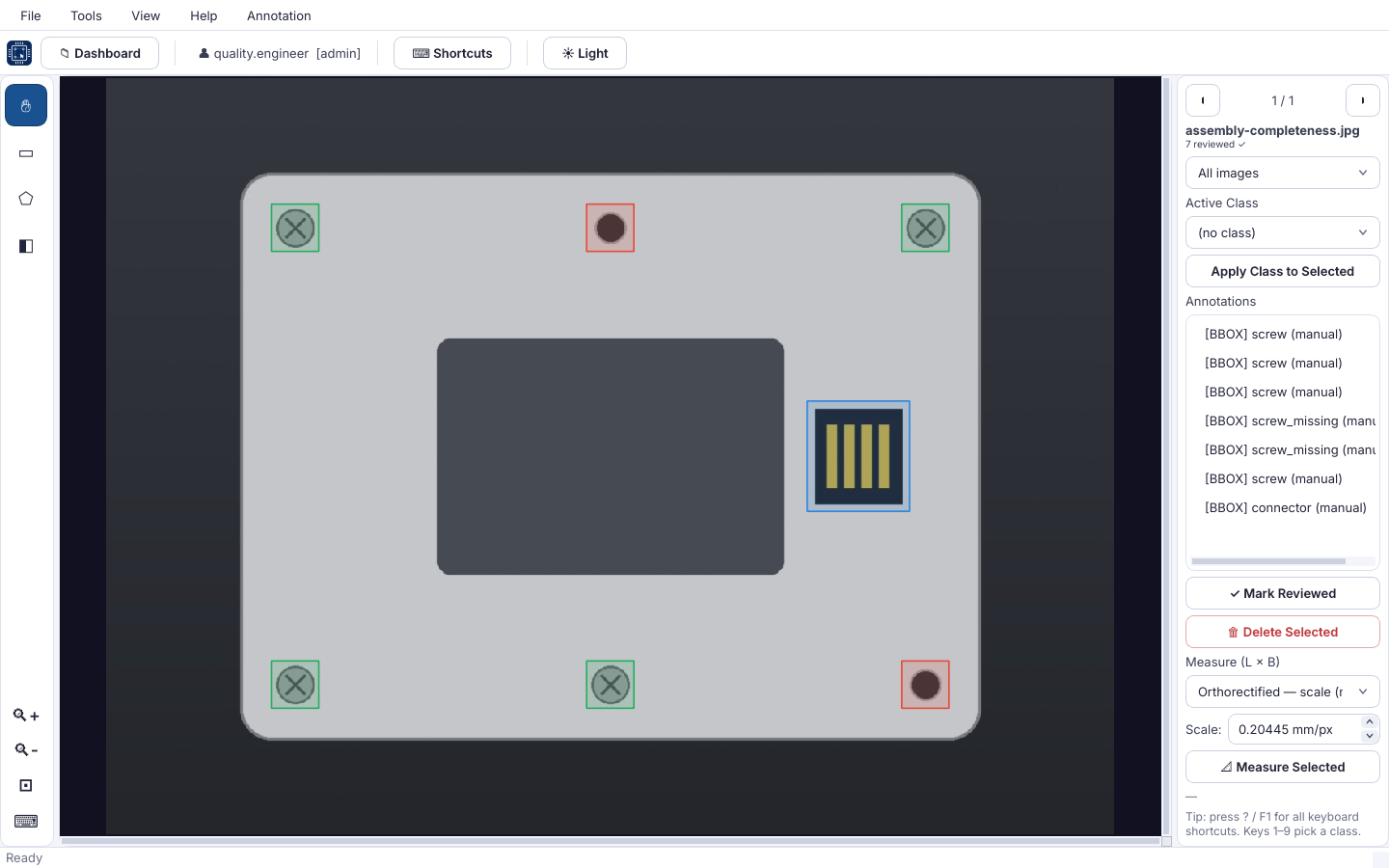
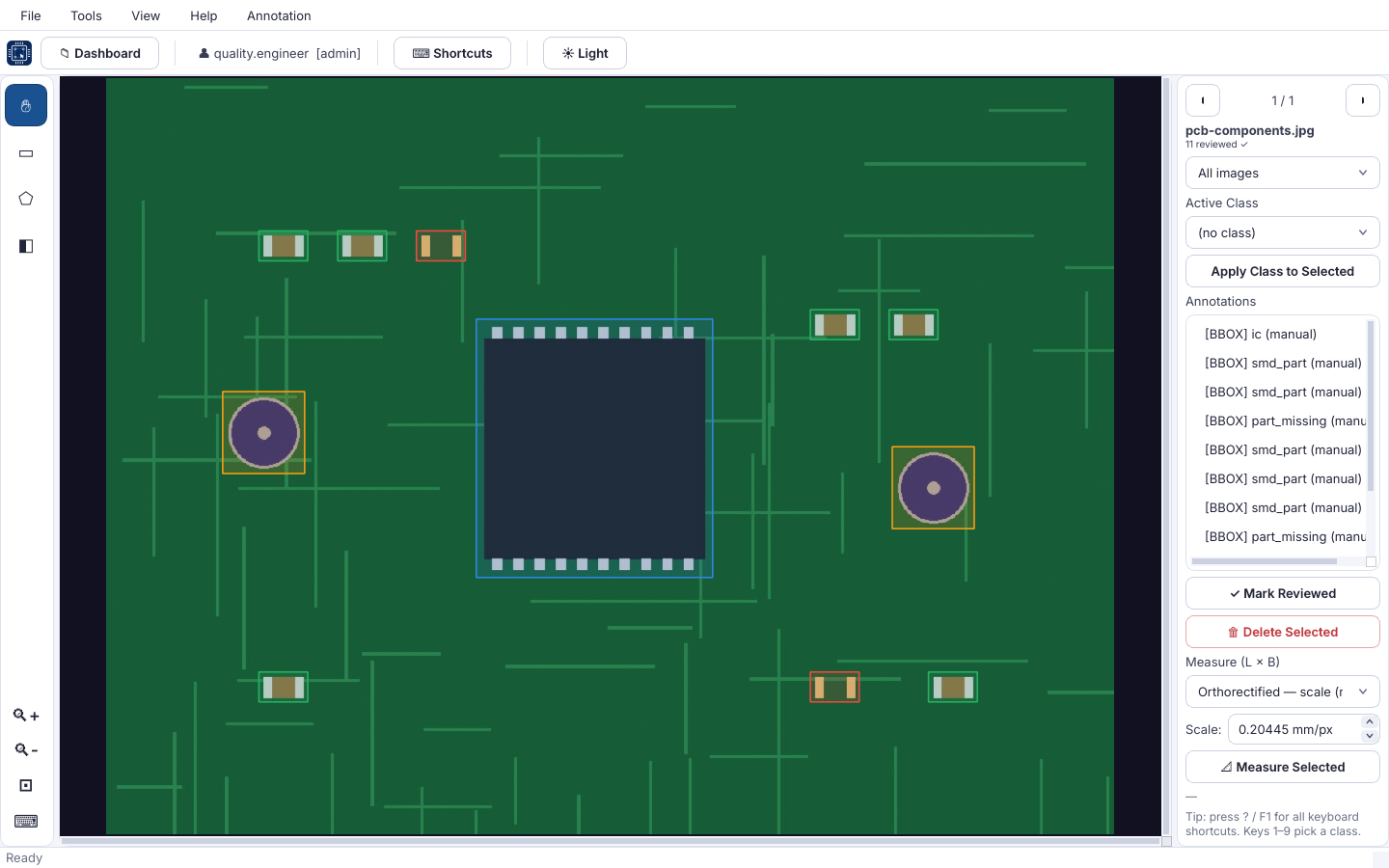
The example screenshots show how each task is labelled in Model Bench. Each class gets its own colour. The images are drawn illustrations made for this manual, not customer images, and they show labels, not model results.
| Use case | What the model finds | Annotation | Edition | Status |
|---|---|---|---|---|
| Surface defects on metal, plastic, painted parts | Scratches, dents, cracks, chips, paint runs | Box or polygon | Standard | Typical |
| Weld and joint inspection | Missing, porous or misplaced welds; adhesive bead gaps | Box or polygon | Standard | Typical |
| Assembly completeness | Missing screws, clips, connectors, gaskets, labels | Box | Standard | Typical |
| Electronics and PCB | Missing or misplaced components, visible solder bridges | Box | Standard; Pro for line speed | Typical |
| Castings and moulded parts | Flash, short shots, surface porosity, burrs | Box or polygon | Standard | Typical |
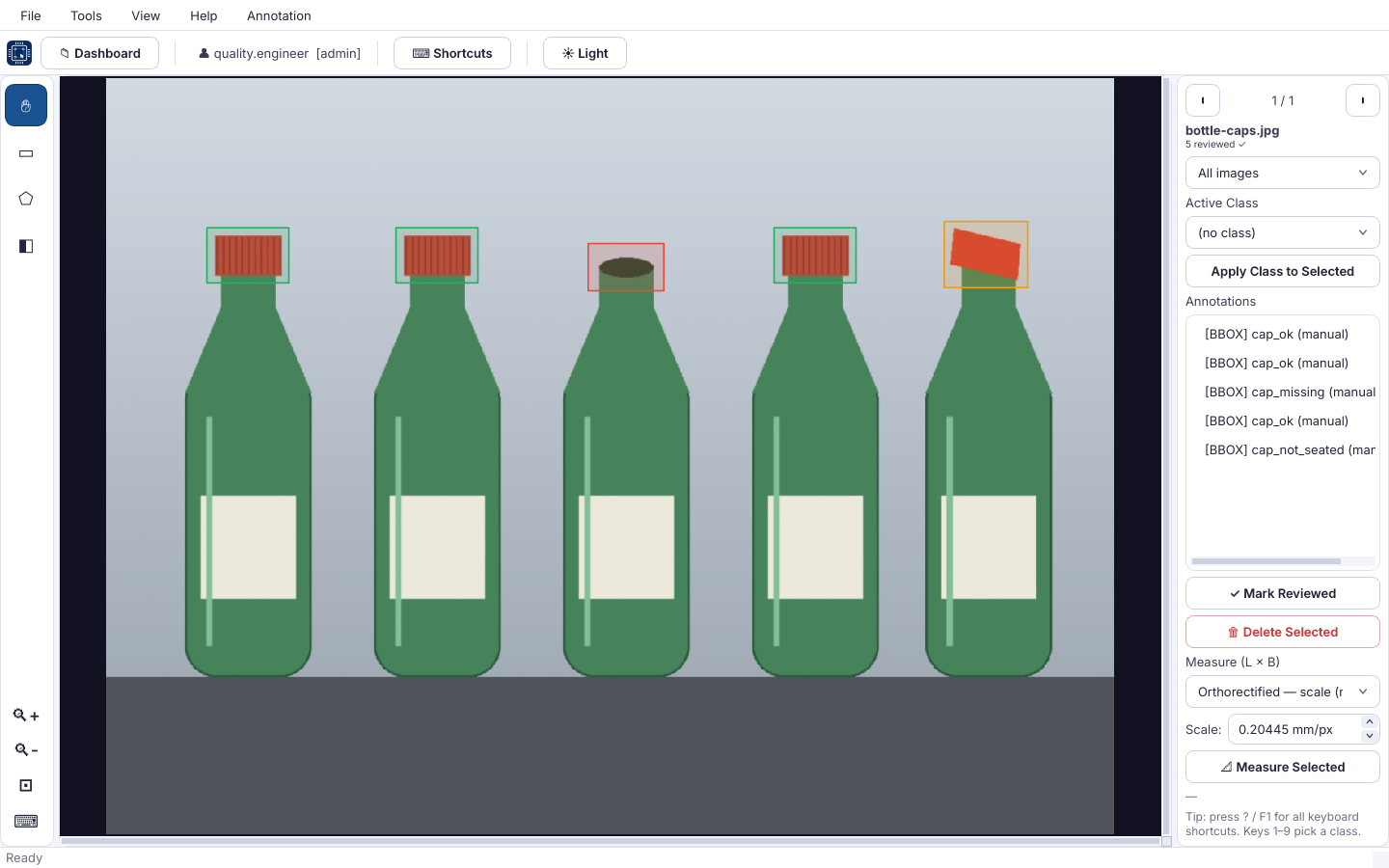
| Glass, bottles and closures | Cap missing or not seated, chipped rim, foreign object | Box | Standard | Typical |
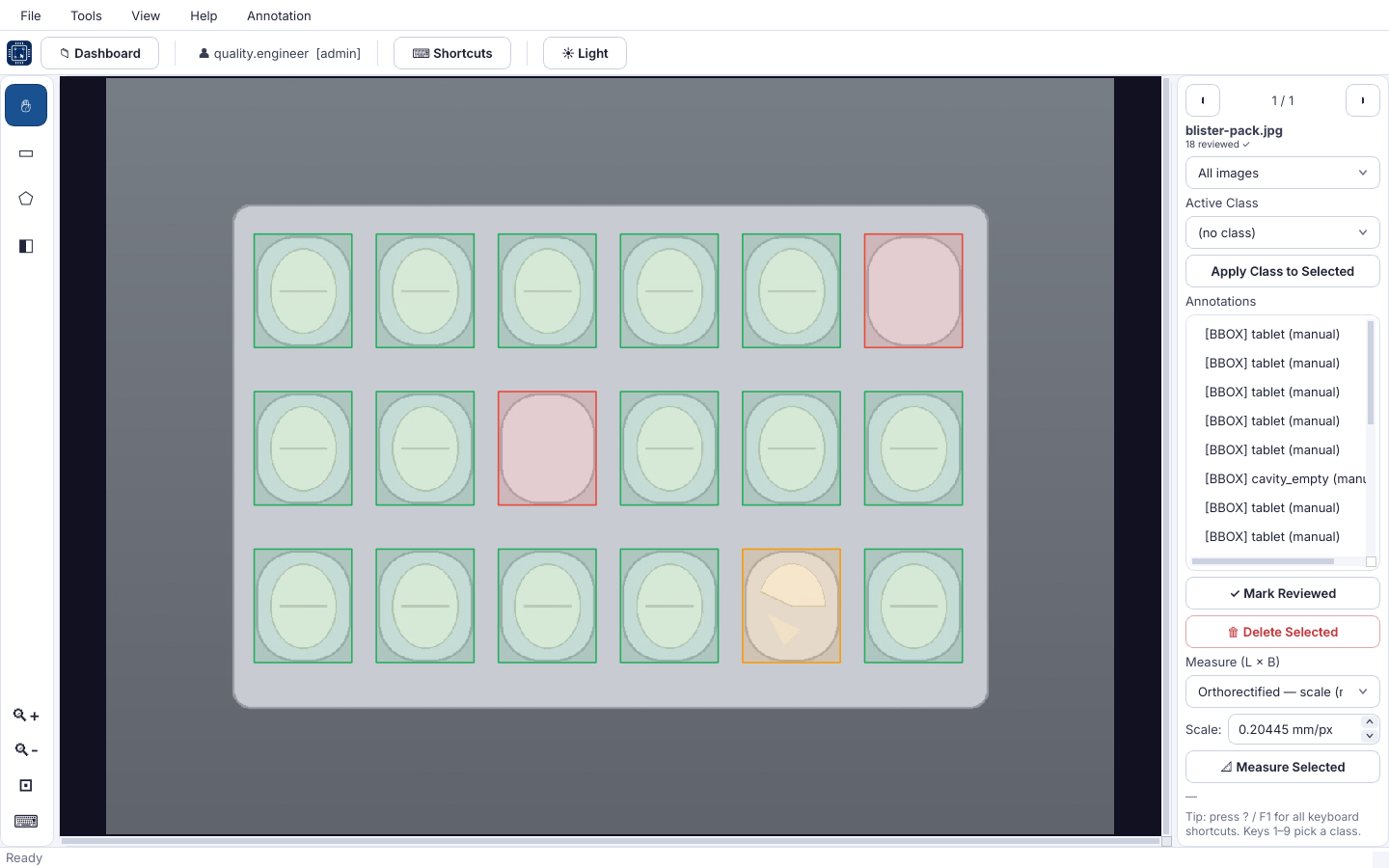
| Pharma and medical packaging | Empty or double blister cavities, broken tablets | Box | Standard | Typical |
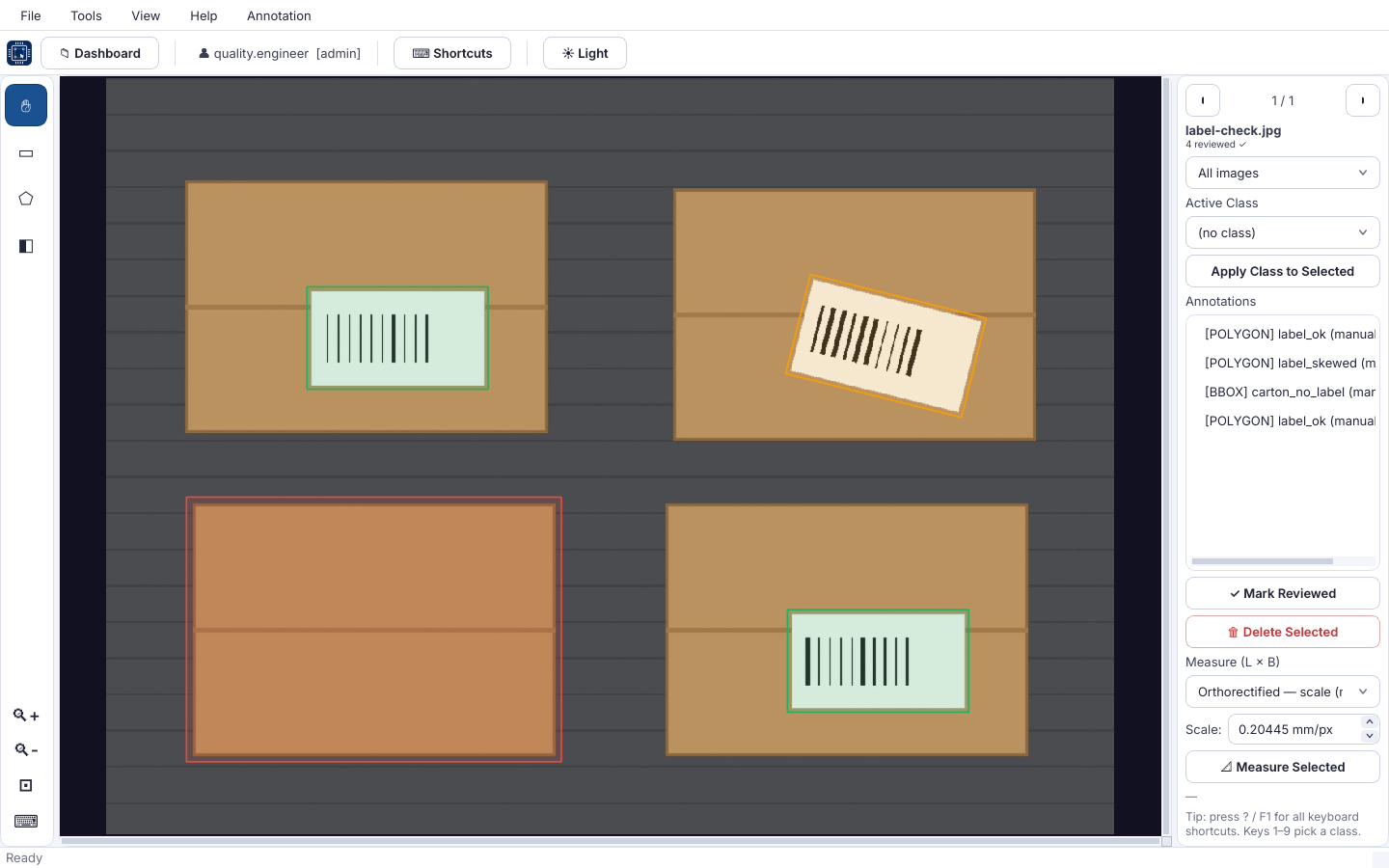
| Print and label quality | Label missing, skewed, torn or wrong variant | Rotated box or polygon | Standard | Typical |
| Textiles, wood and sheet goods | Knots, holes, stains, tears | Box or polygon | Standard | Typical |
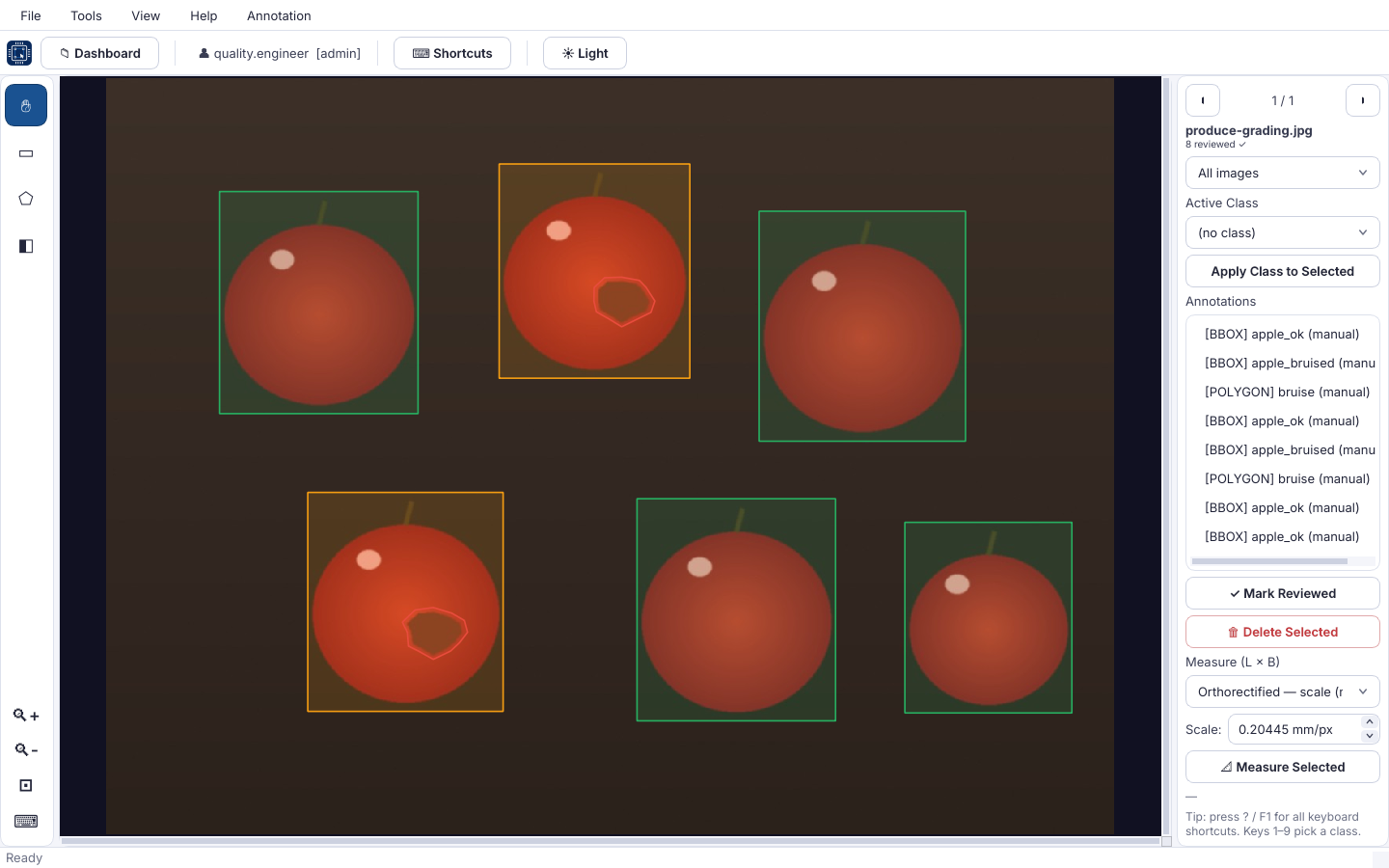
| Food and produce grading | Bruises, blemishes, foreign material, grade classes | Box or polygon | Standard | Typical |
Each defect type becomes a class. The model learns it from labelled examples, and InSiSo Visual Detector publishes the result to the Data Layer for the PLC to accept or reject the part.
Examples
Surface defects. Scratches and an edge chip are traced as polygons, dents as boxes. Classes: scratch, dent, chip.
Assembly completeness. Every screw position gets a box, labelled present or missing, so the model learns both. Classes: screw, screw_missing, connector.
Electronics and PCB. Components and empty pads are boxed. Classes: ic, smd_part, part_missing, capacitor.
Bottles and closures. One box per cap position. Classes: cap_ok, cap_missing, cap_not_seated.
Pharma blister packs. One box per cavity. Classes: tablet, cavity_empty, tablet_broken.
Print and label quality. A label is traced with its four corners, so a skewed label is drawn at its real angle. A carton without a label is boxed as a whole. Classes: label_ok, label_skewed, carton_no_label.
Food and produce grading. Each fruit gets a box for its grade, and the bruise itself is traced as a polygon. Classes: apple_ok, apple_bruised, bruise.
| Use case | What the model finds | Annotation | Edition | Status |
|---|---|---|---|---|
| Parcel detection and orientation on a conveyor | Each parcel, with its four face corners | Rotated box + package corners | Standard (CPU); Pro on Hailo | Measured on hardware |
| Pallet and carton recognition | Cartons and pallets; missing or misplaced cartons in a stack | Box | Standard | Typical |
| Package dimensioning (2D) | Length and breadth of a box face in mm, with a squareness check | Rotated box or 4-corner polygon | Pro | Typical |
| Package dimensioning (3D) | Length, breadth and height from a Helios2 ToF point cloud | Outline on the intensity image | Pro | Typical |
| Shipping label presence | Label present and on the right face | Box | Standard | Typical |
| Counting on a conveyor | Objects per frame, per class | Box | Standard | Typical |
Detection, 2D or 3D dimensioning, barcode and photo combine into a parcel profile. See Parcel dimensioning and profiling.
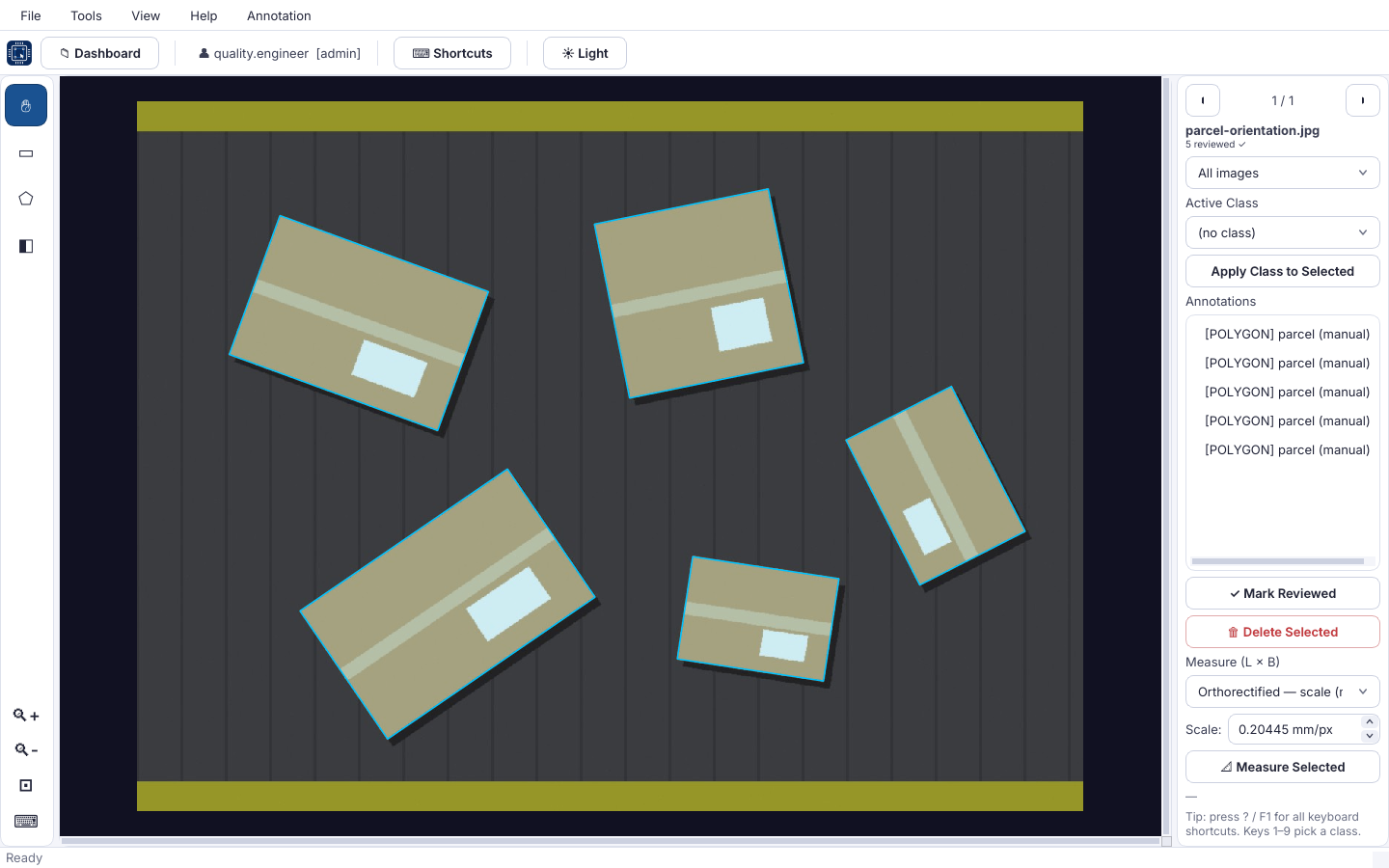
A rotated box gives the position and orientation of each part on the belt. With Pro, the same box is measured in millimetres from the camera scale, and the result goes to CSV or Excel.
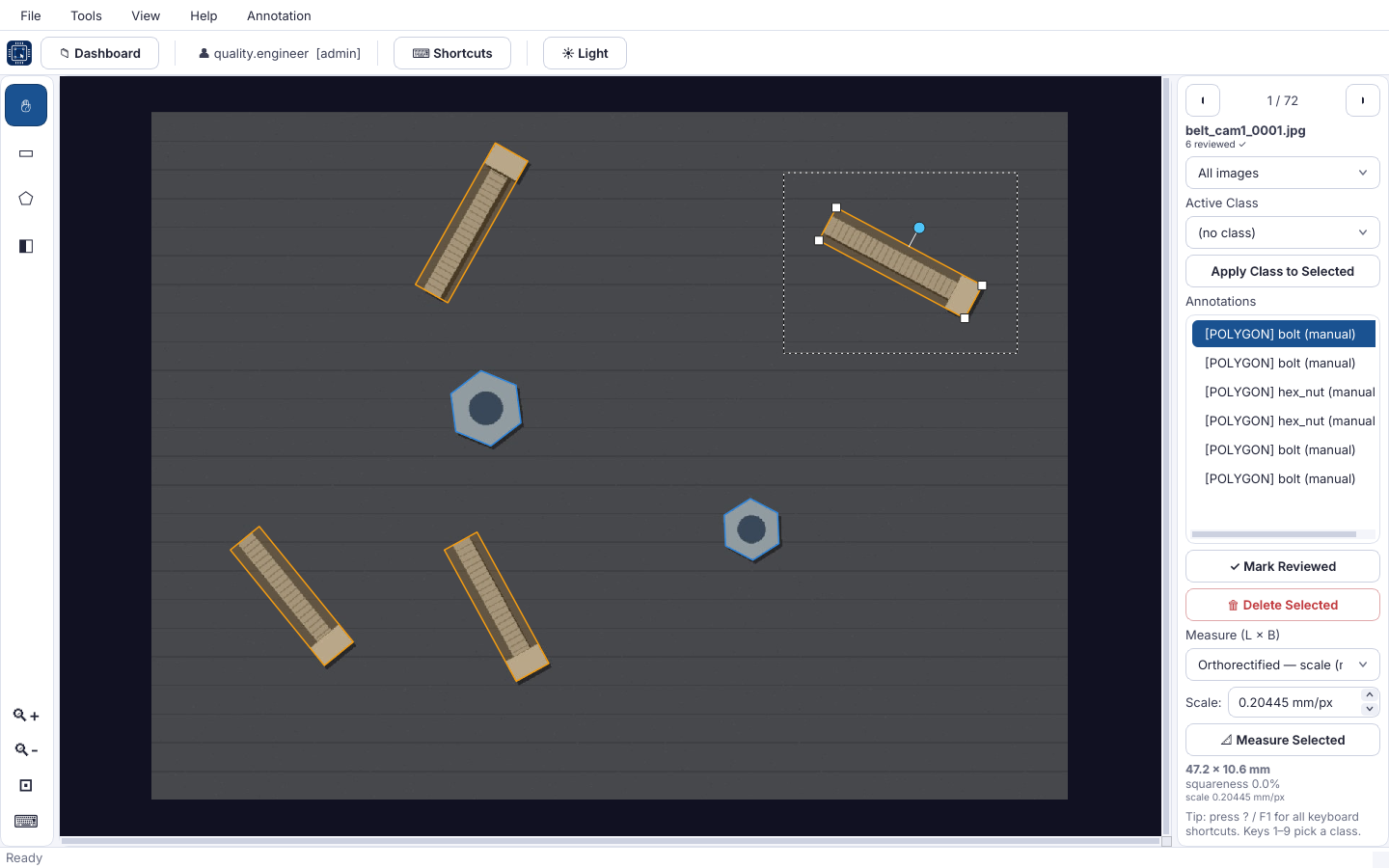
Example
Parcel orientation. Each parcel is outlined as a rotated box, at whatever angle it lies on the belt. The four corners give its position and orientation, and with Pro its length and breadth. Class: parcel.
| Industry | Use case | Edition |
|---|---|---|
| Automotive | Part presence, connector and clip seating, label checks | Standard |
| Battery manufacturing | Visible cell, tab and busbar defects; part presence | Standard |
| Agriculture | Leaf, fruit and produce sorting; foreign-material detection | Standard; Pro on Hailo |
| Robot guidance | Position and orientation of parts for pick-and-place, from rotated boxes and corners | Standard; Pro for speed |
| Machine builders (OEMs) | Vision delivered inside a ctrlX machine; the end customer retrains from real production frames through the ctrlX capture loop | Pro recommended |
| Area monitoring | Person or forklift in a zone, as an advisory signal only | Standard |